

What falling gas prices change about a Thanksgiving road trip
AAA’s November update gives drivers a fresh number. Your route, mileage and local pump prices tell you how much to put aside.
A week before Thanksgiving, regular gasoline was getting cheaper on average even as millions of drivers prepared to get on the road. AAA reported a U.S. average of $3.72 a gallon on November 19, down 18 cents from a week earlier. Its separate holiday forecast, released November 16, projects 72.9 million people traveling by car between November 24 and 30. The price is a dated snapshot. The travel number is a forecast. Both tell you something useful as you work out what it will cost to make it to dinner.
The headline drop is easy to picture on a station sign. On a trip budget, it takes a little arithmetic to see what it buys. A driver covering 420 miles in a car that gets 28 miles to the gallon needs about 15 gallons. At $3.72, that is $55.80 in fuel. At the previous week's implied $3.90 national average, the same drive would cost $58.50. The saving is $2.70. That is real money, and a single $4 toll costs more.
This matters because weekend budgets often get made around whatever price people heard most recently. A large change per gallon can have a modest effect on one tank. A slightly longer drive or an extra car can have a larger effect than the latest update. Give the pump price its own line in the plan and it becomes easier to see which choices actually move the total.
Start with the trip you’re going to drive
Write down the round-trip miles and add the drives you expect to make after you arrive. A weekend that includes a pickup at the train station or an extra dinner across town can be longer than the route between two homes suggests. If the core trip is 420 miles and the trips around town add 56, the 28-mile-per-gallon car now needs about 17 gallons. At the November 19 national average, those two extra gallons add $7.44.
Use an estimate of fuel economy from similar driving if you have one. A dashboard average built up on short city errands may be a poor estimate for a mostly highway ride. A trip with a roof box, steep grades or a lot of sitting in traffic may differ from your usual highway number. For a household deciding which of two vehicles to take, running the arithmetic for both turns a vague impression into a useful comparison.
FuelEconomy.gov points out that a roof box adds drag. Think about whether the items going on the roof actually need to be there. A driver who normally takes the box off between trips can use the last similar trip as a better reference for this holiday than the average from a month of commuting.
Take two hypothetical vehicles on that 420-mile trip. At 28 mpg, the first uses 15 gallons. At 21 mpg, the second uses 20. At $3.72 a gallon, that's $55.80 compared with $74.40, a difference of $18.60. That difference may buy a meal stop or help cover parking. Put it beside the reasons to take the larger vehicle, which might include being able to give somebody a ride or carry the food you promised.
The same calculation helps when splitting the bill. Three adults sharing $55.80 in fuel are looking at $18.60 apiece before tolls or other expenses. Agree ahead of time about whether you're splitting all the trip fuel or just what you buy along the way. Someone who fills up before departure paid for fuel used on the trip even if the others only see the receipt from the return leg. If you want a quick split, use your estimate and round by agreement. If you want to settle against receipts, decide that before the first fill.
Use the national average as a starting number
AAA's published average measures regular gasoline across the country. It describes the direction and level of a broad market at a point in time. The station you use could have a different price, and the grade your car requires may cost a different amount. Check prices near home and near your return departure point for the fuel you will buy. When there is a big difference between the two, the question becomes how much fuel you can reasonably buy at each end.
Imagine the same 420-mile trip with local quotes of $3.90 and $3.50. If you bought all 15 gallons at the first price, the fuel attributable to the trip would cost $58.50. At the second it would cost $52.50. If you use half at each price, the estimate is $55.50. The $6 difference between the first two totals is the most you can save in that example by switching where every gallon comes from. In practice, your tank and route may give you fewer gallons to move.
Keep the comparison just as concrete when a station is off the highway. A place selling fuel for 10 cents less saves $1.20 on a 12-gallon purchase. If the detour adds eight miles, a 28-mpg car uses roughly 0.29 gallon on the extra distance, worth about $1.06 at the November 19 national average. That leaves a 14-cent saving before anyone's time enters the calculation. If you were already planning to stop for a restroom or food at that exit, much of the extra cost disappears because you would have driven there anyway.
Some price listings show a cash price or a member price. If you expect to pay by card or have no membership, use the number you can get. Check when the quote was posted. Treat a low price from a previous day as something to confirm before you take an exit solely to reach it. The larger the gap between stations, the more useful a fresh comparison becomes.
Put a price on the parts the gas receipt misses
AAA's travel forecast covers people going at least 50 miles from home. It reports 81.5 million projected travelers across modes, slightly below the prior year's 81.6 million. AAA still expects the vast majority to travel by car. The accompanying INRIX analysis points to afternoons and early evenings as particularly busy stretches for drivers and flags the Tuesday and Wednesday before Thanksgiving and Sunday and Monday on the way home. Look at the local route and departure window you can actually use.
An earlier start can cut the time you spend on the road. Give any change in departure its own cost, too. Leaving before work is done can mean taking time off. Leaving early with the kids could mean buying breakfast instead of eating at home. People who have more flexibility can check whether moving the drive outside a predicted busy stretch gives them a calmer trip without adding much to the budget. If you are tied to a shift, build time into the drive you can take and choose a stop where everyone can get out if traffic runs long.
A toll road can be the cheaper choice for a driver who would otherwise have to add enough miles, though it depends on the route. At 28 mpg and $3.72 a gallon, gasoline is about 13 cents a mile. Avoiding 20 miles saves about $2.66 in fuel. Whether a $5 toll is worth it depends on what happens to travel time and the rest of the trip. A route comparison is also a chance to check whether the toll you see assumes a transponder or whether a bill-by-mail charge will apply.
Add the costs that are easiest to forget. The extra set of keys might bring an extra parking charge. The car that carries more people might shift the need for meals or stops. If you are renting, the price of replacing missing fuel under the rental agreement is a separate question from the cost of gasoline. Check the return terms and plan any last stop with the airport or drop-off time in mind. A small difference at the pump has less room to help if it sends the driver out of the way at the end of a long trip.
Leave a little room for Friday’s price
If you're building a budget five days ahead, work with a range you can update. At the 15-gallon estimate, moving the price from $3.50 to $4.00 moves the bill from $52.50 to $60. Add your tolls and any planned parking cost to both ends of that range. When the driver gets a fresh local quote, changing that one line is enough. You can still use the rest of the plan.
Bring a little room for uncertainty in the distance, too. If you're choosing between two places to stay, the cheaper room could add a drive to every visit. If you're deciding whether two households can share a vehicle, include the miles added by picking everyone up. A fuel budget becomes more accurate as it begins to look like the route you will actually drive.
AAA's November 19 number gives the plan an up-to-date starting point. Its holiday forecast gives you a reason to take departure times seriously. By the day you leave, the costs to carry with you are simpler. How many miles are you driving? How many gallons will it take? What price can you actually get, and what else is on the route? The answer can fit in a text to the other people in the car. Everyone knows what to expect before the first person reaches for a wallet.
Sources
- AAA · November 19, 2026 fuel-price update
- AAA · November 16, 2026 Thanksgiving travel forecast and INRIX congestion estimates
- FuelEconomy.gov · Driving more efficiently
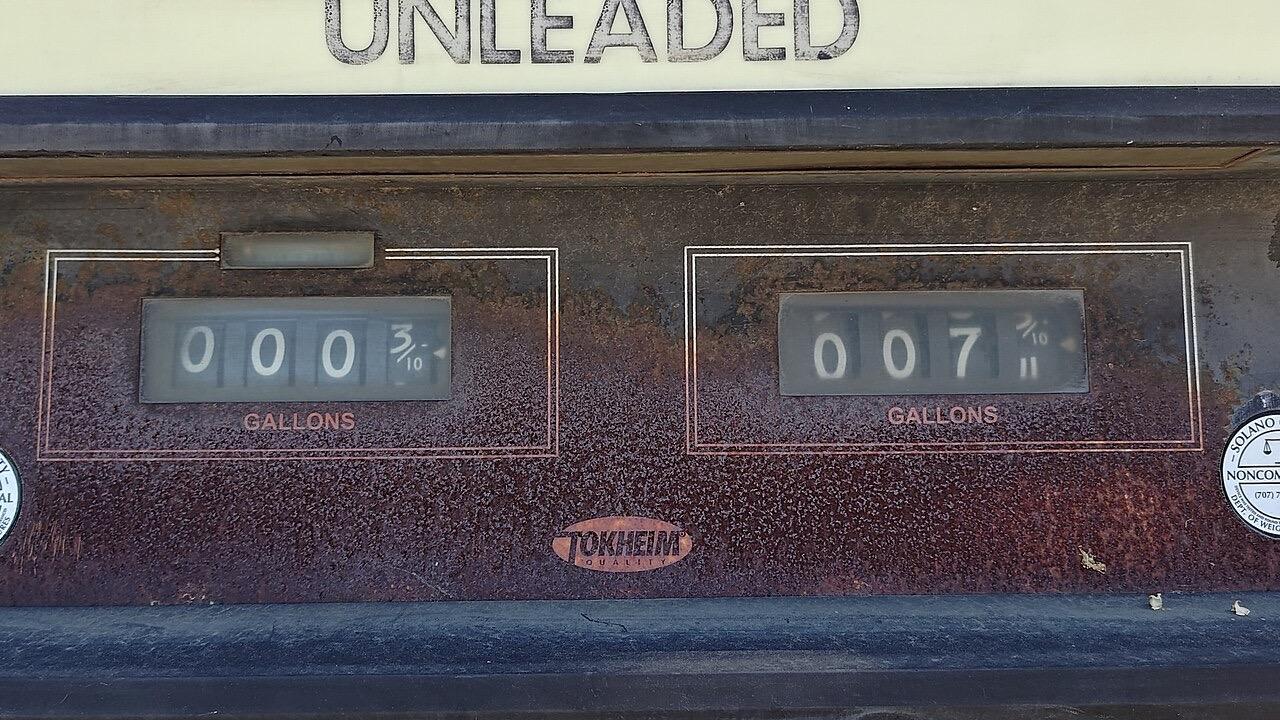
A mechanical counter on a gasoline pump in Vallejo, California, photographed in June 2026. UnifiedFunctionality https://creativecommons.org/licenses/by-sa/3.0/ Display uses a 16:9 crop. Source: https://commons.wikimedia.org/wiki/File:Unleaded_gasoline_pump.jpg