

Fakin’ It XL Review: Pick the Mode for Your Room
Jackbox’s expanded bluffing game earns its place at a party when the host sets it up around how the group actually talks.
Imagine everyone on the couch pointing at the one friend least likely to let an unanswered message sit overnight. For most of the room, that's the job. For the person who never saw the instruction, it is a lot of information delivered at once through eyebrows and elbows. Fakin’ It XL gives that player a few seconds to decide where to point and the rest of the round to explain the decision. At $8.99 at launch, the standalone Jackbox release is an easy recommendation for a host with a group ready to talk over one another in good spirits. Start in person if you have the choice. Buy it for remote play if you already have a way to share a screen and keep a conversation going.
This is an evidence-based review of the standalone game, which launched November 12. Fever used Jackbox's launch materials and published play reports, including Umair Khalid's review of the PC Steam build for GamesHedge and the PC coverage from TheBigBois. The GamesHedge review discloses a code provided through Tinsley PR. The recommendation below is Fever's assessment of that evidence and the design. Features on a storefront describe what buyers can expect to find, and the reports apply to the setups those writers used.
A lie everyone gets to look at
The arrangement is simple enough to explain while people join. The host runs the game. Other players use a browser on a phone or similar device to answer. Most people get instructions tied to a shared prompt, while the Faker has to get by with less information. The group compares what everyone did and tries to pick the person who was guessing. The voting matters, but the invitation to explain an answer is where a group can make the game its own. Sometimes the person worth listening to is the one who knew exactly what was being asked and still made a choice nobody could follow.
The strongest thing about that structure is how little material it asks a player to invent. Writing a fake definition or a funny line from scratch works beautifully with certain friends and makes others feel like they have been sent up onstage. Here an answer can be a gesture or a small choice somebody can explain in one sentence. There's a difference between asking a guest to come up with a joke and asking why they chose you for an absurd imaginary responsibility. The second question already has half a joke in it. A newcomer has something they can do before they have worked out how the room usually sounds.
The classic round formats use movements most people can recognize at a glance. Hands of Truth uses a raised hand, Number Pressure makes fingers into numbers and You Gotta Point gives everybody a target in the room. Those small differences affect the kind of mistake a Faker can make. Holding up a hand puts you on one side of a question. Pointing can reveal a completely different understanding of what your friends were likely to do. There is a real advantage in looking where others look, which is why a couch full of people gives the game a kind of energy a text exchange cannot provide. The smallest hesitation is something everybody can discuss.
Jackbox has added formats that put the uncertainty in the response itself. In Emojional Damage, most players see a specific question and use an emoji to respond. The Faker has a broader clue about what kind of symbol fits. Even an answer in the right category can need an explanation. Thumb Luck uses three successive up-or-down judgments, which means an apparently lucky guess only buys the Faker a little relief. TheBigBois also calls attention to the final Text You Up round, where altered questions draw out answers before the Faker learns their role. There's a design sense to giving the end of the game its own wrinkle. After a room has spent time watching who looks shifty, the final round makes the evidence a set of answers people supplied with incomplete knowledge.
Remote mode answers a real problem
Playing remotely is a reason to choose XL over the first version of Fakin’ It. The publisher describes a mode for friends joining over a stream or call, with avatars taking over the gestures that would otherwise require the group to see the same couch. That matters particularly for pointing, which is clear only when the people you're choosing from occupy the same space. There's also a gain for the person who would rather make a choice with a device than perform it for a roomful of faces. Jackbox's design lets the host decide which kind of evening is on the calendar before the game starts.
The independent impressions qualify that win. TheBigBois liked the addition and pointed to early players who were finally able to take the game to a group that doesn't live nearby. GamesHedge found the remote setup still has inconveniences and emphasized the dependence on a second screen. Those positions can coexist. A substitute for pointing repairs a gameplay problem. Getting friends into a call, showing them the host screen and making sure they can answer while following the discussion remain jobs someone has to do. One of those jobs is harder if a guest has a single small screen doing everything.
A sensible remote host should decide where the voices will go first. Use a call or stream setup people already know, then have each guest open the controller page somewhere they can reach without losing the game. Give people a moment to see that the shared screen and their own answer display are different things. If there is a substantial delay between a guest seeing the host screen and hearing the room's reactions, a bluffing game is a poor place to troubleshoot it. Timing is one of the clues. Solve the timing problem before making it part of somebody's alibi.
GamesHedge also reports that there is no general matchmaking queue or AI to make up the numbers. A room code connects an invited group. That is useful context for a prospective buyer who sees a cheap multiplayer game and expects to find someone to play with each evening. The value here rises quickly when you have an established group. Eight-player support gives a host more room than the original six, though a loud group may want a little help hearing explanations before the vote. The publisher's product page lists three to eight players. At either end of that range, the host's job is closer to handing around the microphone than keeping the score.
A good first round is worth more than a big bundle
Khalid saw repeat prompts over his time with the Steam version. TheBigBois likewise reports a repeat within a session it observed. Repetition matters in a game built around the instant when a group realizes it has heard something different. Once you remember what made everyone point at the same person, some of that uncertainty goes away. But a round still has room for variation when the Faker changes or the people answering have different histories together. The risk is highest for a group planning to make this the only game at a long party and lowest for a group that will bring it out occasionally between other things.
The low standalone price is persuasive for anyone who already knows the shape of the game. The publisher also pitches bundles that combine it with The Jackbox Party Pack 12, with a larger Steam bundle adding Trivia Murder Party 3. Someone outfitting a first holiday game night might reasonably want variety. A host who wants one game to play with a faraway group has a much clearer decision. Buy the standalone if the group wants to bluff. Compare the bundle only when the other games would get actual screen time. Check the storefront for your host device before inviting the group. Jackbox's November 12 release lists Nintendo Switch and Switch 2 alongside PC, PlayStation and Xbox, updating an earlier announcement that put the Switch launch later in the year.
The other publication worth checking before a family session is the age rating. XL was designed to take the remote-friendly structure of Fakin’ It All Night Long in a less risqué direction, and Jackbox also brought back material from the original. That history explains why two games with nearly the same name can belong in different kinds of gathering. This one is rated T for Teen. If a group includes young players or people who would rather keep personal questions light, that distinction should enter the buying decision earlier than the number of new round types.
The best place for Fakin’ It XL is the first pocket of unstructured time after everybody arrives. It gives a room a shared subject quickly, and a person who rarely volunteers to go first can end up with the answer everyone wants explained. Pick it up if you've got the guest list for that kind of game. Pick remote mode for a group that already likes to talk together from different places, and leave enough time to get both screens working. If the gathering has never been able to hear the person at the far end of the call, the game is one more reason to fix that before the weekend.
Sources
- Jackbox Games launch announcement
- Jackbox Games’ Fakin’ It XL product page
- Xbox storefront listing and Teen rating
- Fakin’ It XL on Steam
- Jackbox Games’ release announcement via Games Press
- Umair Khalid’s firsthand PC Steam review for GamesHedge
- TheBigBois’ PC coverage
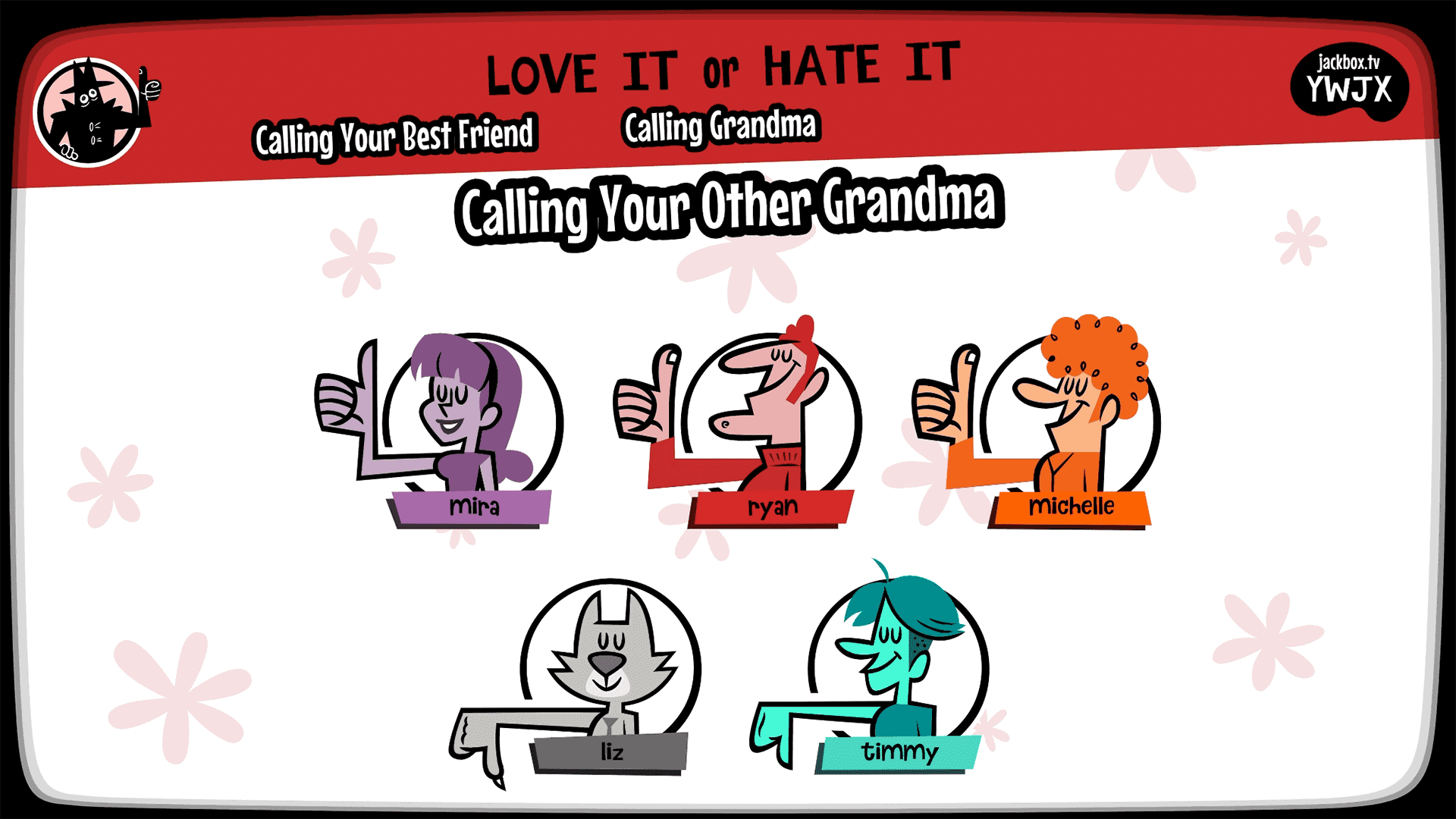
Illustrated avatars stand in for players’ gestures in an official Fakin’ It XL screenshot. Jackbox Games