

Blacksmith Master 1.0 puts the workshop in charge
Untitled Studio’s medieval management game has left Early Access. Its new specialists and oversized commissions ask what happens when one good smith has to become an entire business.
A customer can see the sword on a rack. Behind the counter are the people who brought in the ore, turned it into an ingot and sent that ingot through a succession of stations. In Blacksmith Master, the shopkeeper can look directly at that chain. Untitled Studio’s management game left Early Access on November 19, and its 1.0 update turns the relationship between the shop floor and the sales floor into an even bigger part of the job. The forge still needs someone who knows how to work metal. It also needs a manager who can spot where a pile of unfinished work is about to form. Hooded Horse release announcement
The PC launch covers Steam, GOG, Epic Games Store and Microsoft Store, according to publisher Hooded Horse. The developer says Early Access saves carry forward, so returning players can bring the operation they already built into the new systems. That matters more here than a line of patch notes might suggest. The value in an existing save is in the rooms a player laid out, the staff they trained and all the little fixes they made when a shipment or rush of customers exposed a weakness. Version 1.0 gives that shop another problem to solve without asking it to start over. Hooded Horse’s launch page, developer’s release note, mirrored by SteamDB
A counter at one end and a mine at the other
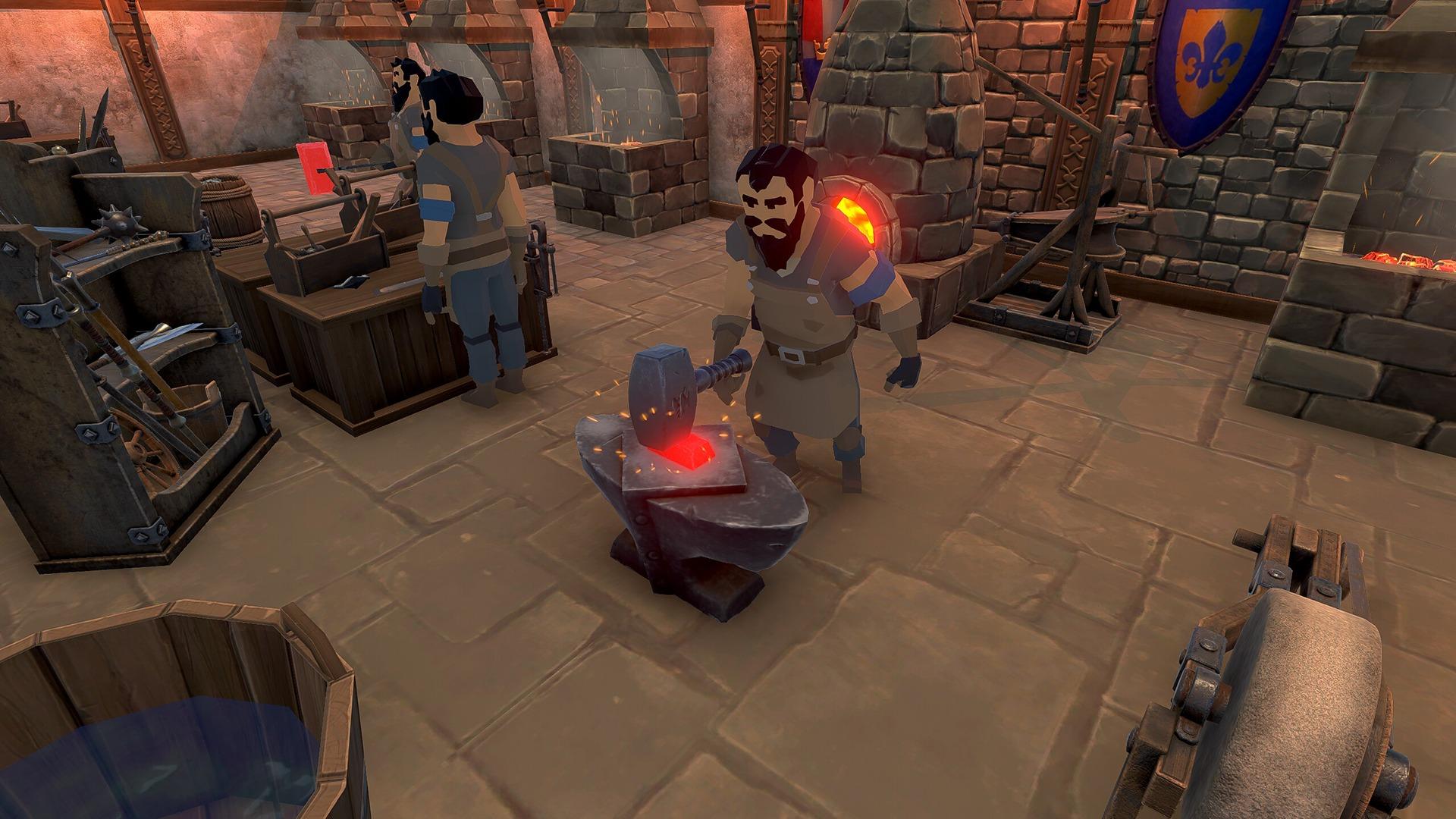
The game’s store description starts with extracting raw materials and ends with selling finished goods. You can develop mines and logging camps, furnish the workshop with equipment, hire people for the various jobs and decide what to sell or make on commission. You can also take direct control of a smith and do some of the work yourself. There are two reasons to want both perspectives. The close view shows how a piece gets made. The pulled-back view shows why a great smith can spend a perfectly good afternoon waiting for the materials that would let them make it. Steam store and gameplay overview
An imagined shop makes that distinction easier to see. Say you add a bank of workstations because your first bench is always busy. If your problem really is a shortage of places to work, the extra capacity might help. If the new benches sit idle beside the original one, look upstream. A shortage of ore or a long delivery route calls for a different answer. Maybe the workers can make the parts, but some of them spend too much of their day walking between a stockpile and their stations. A management game can make a small rearrangement feel more consequential than a big purchase when the rooms give you enough clues to work out what keeps stopping the line.
The shop complicates that setup in a useful way. The publisher presents retail as a regular source of income and bulk jobs as another way to sell your work. The two channels pull on the same production capacity. A counter that consistently has stock to sell takes a different rhythm from a workshop committed to meeting one large order. Keep filling the shelves and the merchant may wait. Throw the entire workforce into the merchant’s job and a steady source of income may get less of your attention. The interesting decision is how much capacity you need to protect for the small transactions while working toward a larger payout. Publisher’s September release announcement
The specialist changes everyone else’s job
Version 1.0 introduces Master Workers. The developer’s preview says players can hire one of each type, with six specializations in the release. A Master Blacksmith can open up particularly large siege orders. A Master Cashier can keep customers from losing patience while they wait. Those benefits operate in different parts of the business. The blacksmith gives the manager a bigger problem to solve upstream. The cashier takes pressure off the final transaction. Hiring either changes what the player should examine the next time the place slows down. Developer’s 1.0 feature preview, Hooded Horse’s release-day announcement
Think through the cashier’s job first. If customers will wait at the register, a burst of arrivals stands less chance of eating into sales at that one point. There’s still the question of what they can buy when they reach the front. If a display runs empty, patience buys time to fix the symptom. Keeping that shelf supplied sends you back toward the benches and material inputs. A perk in one room can give you a clearer picture of another room’s problems.
The Master Blacksmith presents the reverse case. A new ability opens up a lucrative-looking commission and immediately puts the rest of the workshop under a brighter light. Can people retrieve enough material? Can they keep several production steps moving at once? Is there somewhere for work in progress to sit? Version 1.0 adds five siege machines, an overtly medieval reward for people who are interested in the much less glamorous question of how a workshop handles an order measured in triple digits. The developer also says the update improves pathfinding. That change bears watching in an old save, where the player may know by heart which doorway the staff had trouble negotiating. The launch material establishes the update’s intent. It takes play across a range of shop layouts to see how consistently the change works. Developer’s 1.0 feature preview, Hooded Horse’s release-day announcement
Why a completed shop is an interesting starting point
The game’s route out of Early Access included coin minting, revisions to wages and progression, and a reworked mastery tree. The publisher credits Untitled Studio, the one-person Serbian studio behind Tavern Master. That earlier game asked players to run a business through daily activity people recognize immediately. A room fills up, an employee crosses it carrying something and a customer either gets served or keeps waiting. Blacksmith Master adds the material chain on top of that familiar picture. A finished object in its shop also represents labor that started much farther away. Hooded Horse’s development recap, Untitled Studio press kit
There is a design benefit to putting visible people between the raw input and the final sale. A spreadsheet can tell you that production fell below demand. A crowded workshop can give you an idea of whose time is disappearing and where it went. You still have to interpret what you see. A station with everyone gathered around it may be the one that needs attention, or it may just be the place work gathers because something else has stopped. The economic loop gives that little observation a consequence. Guess wrong and you have built a more expensive version of the problem. Guess right and the people you already hired have a better chance to do the work you hired them for.
The smallest pieces of the medieval fantasy help sell that distinction. The publisher’s examples include cookware and tools alongside familiar swords and armor. A pot belongs to the same economy as a showpiece weapon, but each gives the player a different mental picture of who might want it and why. That variety helps a shop feel like a business that belongs to a town. The siege orders can then sit at the far end of a scale the game already teaches through everyday goods. Start giving several workers enough to do and you can see how the business might grow into the kind of place that takes on a contract most small smithies would have to decline. Steam store and gameplay overview
A commission is a useful way to see the difference between getting through a good day and running a business that can repeat one. In an ordinary retail shift, a short delay at a bench can be invisible to a player whose shelves are already full. A large batch of the same item makes that delay recur, and each repetition makes it clearer which station has become the limiting step. That does not automatically make the largest available commission the best one to accept. It gives a player who wants to redesign the shop a job large enough to show whether the redesign made a difference. There is a pleasure in recognizing that the workshop you built for a dozen small sales needs a different pattern of movement to do a single enormous job.
The studio also lists random events among the release changes. A workshop arranged for its best day may leave little room for a disruption. The version 1.0 material gives experienced players a reason to reconsider what slack is worth, whether that means keeping stock on hand or leaving space to change the layout without rebuilding the entire floor. Developer’s 1.0 feature preview
The first thing to watch after opening the doors
Returning players have a particularly good before-and-after comparison available. Pick a product the old shop can make comfortably. See which parts of that workflow stay reliable, then look for one place a Master Worker can take pressure off. A retailer with shelves that empty too quickly has a smaller, clearer experiment available than a manager who hires every specialist and accepts the most demanding order at once. As a design proposition, the new hires make the most sense when players already know what work each one would change.
A first-time player can ask the same question on a smaller scale. When a simple product stops making its way to a customer, trace it back through the room. That small exercise tells you more about whether Blacksmith Master is your kind of game than the prospect of eventually building the biggest shop. Some people want to hammer the metal themselves. Some want to find the single change to the room that lets five other people get on with it. The idea behind the November release is that both of those impulses can belong to one craft. The shop floor is where they meet.
Sources
- Hooded Horse and Untitled Studio, Blacksmith Master release-day press announcement
- Hooded Horse, official Blacksmith Master page
- Hooded Horse, September release-date announcement and Early Access recap
- Untitled Studio, November 1.0 feature preview
- Untitled Studio, release and save-compatibility notes, mirrored by SteamDB
- Hooded Horse, release-day community announcement
- Blacksmith Master, Steam listing and developer description
- Untitled Studio press kit
A smith works at a glowing anvil in an official Blacksmith Master gameplay screenshot. Capture build unspecified. Photo credit: Untitled Studio / Hooded Horse.