

Ali Wong and Stephanie Hsu get the keys to Cinderella’s story
In Netflix’s Steps, a stolen wand puts two sisters in charge of a fairy tale that usually finds its heroine at the ball.
Lilith has the dress and the wand. The picture Netflix released of Ali Wong’s animated character in the middle of a palace staircase gives her the kind of entrance most Cinderella stories reserve for somebody else. She has taken the Fairy Godmother’s wand, and she and her sister Margot intend to interrupt the royal ball. That shift sets Steps, which began streaming on Netflix on November 20, in motion. Alyce Tzue and John Ripa direct the animated feature, with Stephanie Hsu as Margot and Amanda Seyfried as Cinderella. Netflix’s release-day coverage credits the sisters with starting a chain of events that leaves their kingdom in the hands of a new ruler.
A different point of view can be as simple as giving a character a few extra scenes. The premise of Steps makes a bigger commitment. The wand comes with enough power for Lilith to change everyone’s prospects at once. She makes a decision with public consequences, and the story then asks what she and her sisters owe one another. A makeover can take one person out of a bad household. This is a story about three people who may have to figure out how to live together after the makeover.
A ball with two agendas
The ball is an efficient piece of storytelling. The invitation establishes who gets into the room. The clothes announce who belongs there. The prince gives the crowd a center of attention, and midnight puts a time limit on the fantasy. In a story built around Cinderella’s departure from the household, the stepsisters usually give the scene its obstacles. Put their wants at the center of the same evening, and the ball becomes a chance to see the household’s tensions play out in front of everybody.
In the Netflix Animation release materials, the breach gives Nikki Glaser’s Priscilla an opening to take the throne. Cinderella and Lilith eventually have to cooperate, with threats outside the palace ranging from a gang of biker trolls to the Screaming Woods. There’s a useful difference between the charges in those two halves of the premise. One sister decides she has had enough of her place in the family, and an opportunist uses the disruption to expand her own power. Treat those actions as morally interchangeable and the family story becomes fairly simple. Give them different motives and there’s room to ask what an apology can repair, and what needs more than an apology.
The change also complicates the wand. Cinderella usually needs someone with magic to give her access to the ball. In this version the question is what happens when the first person granted access to that power makes a mess with it. A fairy tale can skip a lot of the everyday work that comes after a satisfying transformation. A wand can send everyone to the party. It cannot decide how they will behave once they get there.
Lilith and Margot have different parts to play
Wong told Netflix that part of the draw was playing someone who has a lot of resentment to work through. That gives Lilith a specific problem for an actor to play, through a film in which she has to become more attentive to the very person whose attention and privileges have bothered her. A performance that gives the resentment its full weight can allow a later moment of generosity to feel like a choice. If the resentment is always treated as an amusing bit of attitude, the journey back to her sisters has less distance to travel.
Hsu has a different job. Netflix’s cast guide describes Margot as an impulsive younger sister who takes an unusually keen interest in frogs. She also keeps finding herself between Lilith and Cinderella, trying to get them to get along. Producer Jane Hartwell singled out the optimism Hsu brings to a role that includes, for a while, being a frog. Margot can be a source of comic movement in the story and still have a concrete stake in how the other two behave. Anybody who has tried to mediate a family disagreement knows how quickly the person in the middle can become responsible for everybody else’s feelings.
Wong and Hsu arrive with credits that make this division of labor interesting. In Beef, Wong played a business owner whose escalating feud repeatedly ruptures the image of competence she works to maintain. Hsu’s dual role in Everything Everywhere All at Once put a strained family relationship inside an outsized genre adventure. Their characters here have different pressures and the scale is designed for a family audience, but both actors have played women whose grievances survive a change of setting. That experience makes them interesting company for a story in which an actual spell can rearrange the world and a family still has to deal with its old arguments.
Wong told Tudum she wants her daughters to have several Asian American leads to choose among when they watch movies. It’s a pointed way to describe what casting can do in a story like this. A single role can get saddled with the obligation to be someone everyone recognizes as admirable. Two characters in the same family can have distinct temperaments and react differently to the same problem. Audiences get to decide which one they understand, which one makes them laugh and which one they would least want to share a kitchen with. In this case one of the sisters is an instigator, and the other is trying to keep the family talking. Each can get something wrong without standing for the whole family.
Why Cinderella stays in the picture
A familiar joke in a fairy-tale revision is that the original heroine must have had it easy. The material Seyfried and Netflix describe offers a more interesting choice. Their Cinderella tries so hard to be good, and to do things properly, that her usefulness becomes part of how she expects to earn love. That gives an old catalogue of chores a new context. Even the habit that makes somebody everybody’s favorite can come from uncertainty about what would happen if she put the broom down.
It also means Seyfried’s version of Cinderella can be on the receiving end of Lilith’s envy while dealing with a problem of her own. If the film gives both experiences room, the two actresses can play the same argument from different positions without the audience having to decide in advance which woman deserves to speak. Margot’s wish that everyone find a way to get along makes considerably more sense when it involves three people who all have something to lose.
Tzue told Netflix that growing up Taiwanese in suburban New Jersey informed her interest in the story. She described feeling awkward and out of place and drew a connection between that experience and the film’s questions about belonging. Her co-director Ripa also pointed to the decision to give the wider cast more than their usual stock functions. The angle is visible even in the choice to have a Fairy Godmother voiced by Bette Midler whose good intentions can get ahead of her judgment. Young Mazino’s Gef, a troll who lives apart from his community, extends the same question of belonging beyond the royal family. It matters whose company the sisters find as soon as they leave the rooms in which everyone already has an opinion about them.
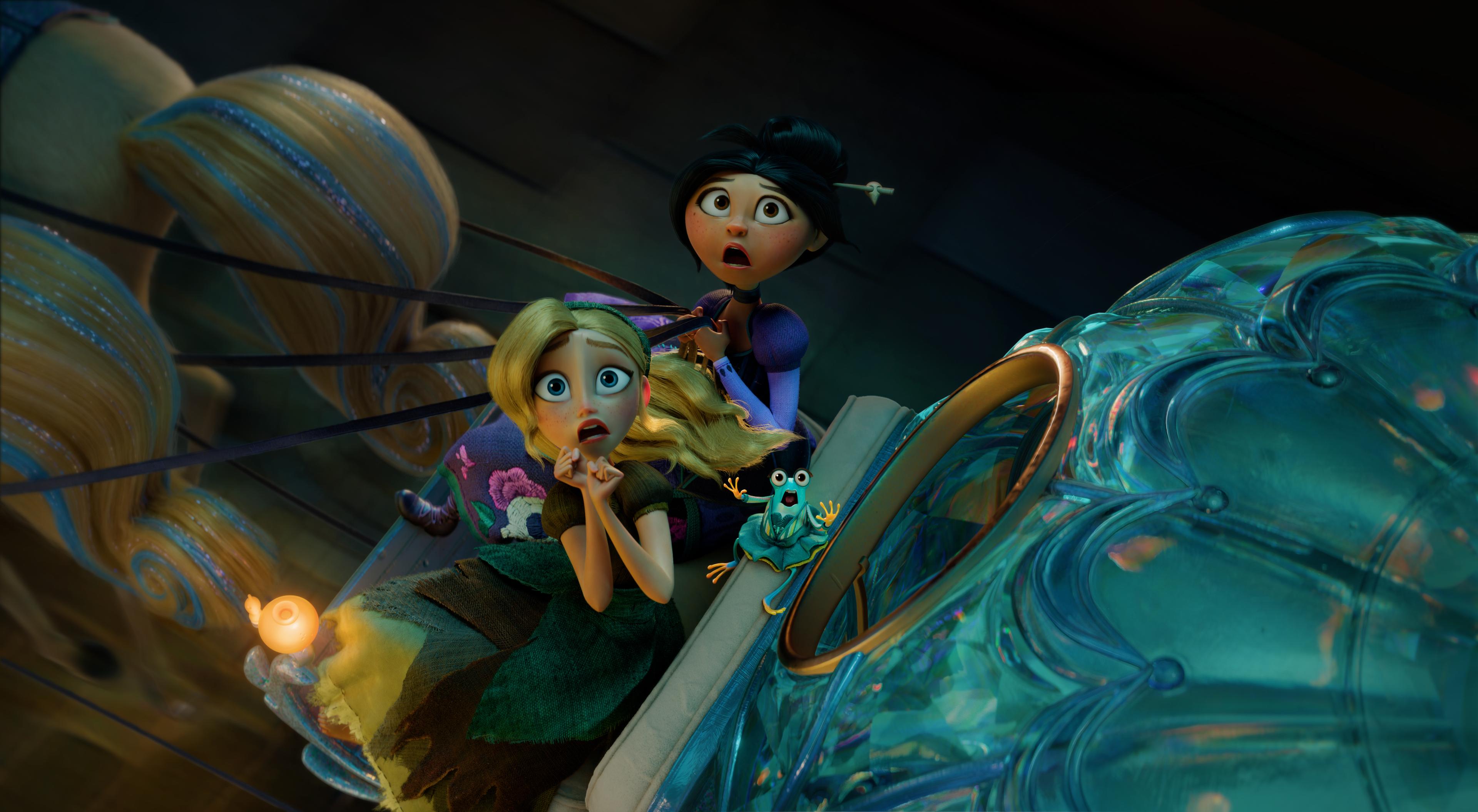
The new version still makes room for the flourishes someone would put on a Cinderella poster. There’s a prince, voiced by Daniel Radcliffe, and the publicity art gives the palace the kind of wide staircases built for a grand entrance. In another studio still, Lilith, Cinderella and Margot share a carriage, with Margot in her frog form. That image makes an economical case for the adaptation. Each figure is at a different height and reacting to the same danger. The carriage has an unusual number of people to carry this time, and the figure who looks smallest has as much reason to be frightened as the one in the middle.
The adventure makes the family visible
The source for the character details here is Netflix’s released synopsis, publicity stills and cast interviews. Those materials make the premise easy to place in the line of retellings that give an old supporting character more to do. They also suggest a particular measure for this film. A movie can turn the stepsisters into leads and still spend most of its energy celebrating the reversal. The harder scenes to pull off are the ones after the disruption, when Lilith has to let somebody else describe what happened and that somebody is her stepsister.
One of the more useful things about a recognizable tale is how easily a family can talk about what has changed. Children who know the ball as the middle of a romance have a direct way into this story. Ask who gets to make the decision in that scene and what each sister thinks it will do for her. Adults may recognize the social usefulness of the girl who tries to do everything right, or the awkward position of the sibling asked to absorb a fight she did very little to start. The fantasy opens up those parts without demanding that the audience retire the older story.
The palace scene gets the movie going because the wand allows Lilith to do something drastic before anybody can stop her. The chance for the movie to be memorable comes later, when carrying a wand is no substitute for listening to the people stuck in the carriage with her. That is a lot to ask of a Cinderella story, and a good reason to give the stepsisters the room.
Sources
- Netflix Tudum, November 20 release and production interviews
- Netflix Tudum, cast profiles and interviews
- Netflix Animation’s Annecy newsroom release and publicity stills
- Netflix Media Center, Steps
Lilith (Ali Wong), Cinderella (Amanda Seyfried) and Margot (Stephanie Hsu), in frog form, share a carriage in Netflix’s Steps. Netflix Animation © 2026